Devpost
Participate in our public hackathons
Devpost for Teams
Access your company's private hackathons
Grow your developer ecosystem and promote your platform
Drive innovation, collaboration, and retention within your organization
By use case
Blog
Insights into hackathon planning and participation
Customer stories
Inspiration from peers and other industry leaders
Planning guides
Best practices for planning online and in-person hackathons
Webinars & events
Upcoming events and on-demand recordings
Help desk
Common questions and support documentation
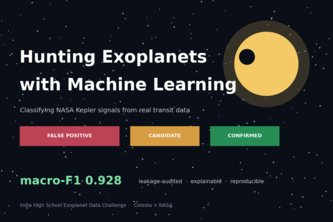
A leakage-audited XGBoost that sorts NASA Kepler signals into confirmed planet, candidate, or false positive — 93% F1, fully explainable, and honest about what starlight alone can't reveal.
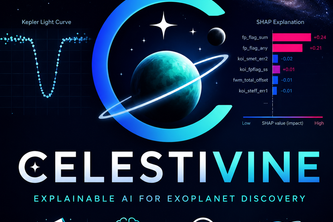
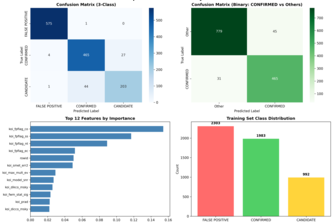
Explainable AI for Exoplanet Discovery using Random Forest and SHAP, enabling astronomers to understand why a Kepler Object of Interest is classified as a planet candidate or false positive.
Combining raw NASA observational data with advanced physical feature engineering to hunt for exoplanets with 96.8% precision.
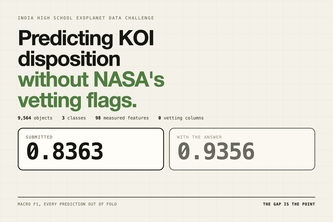
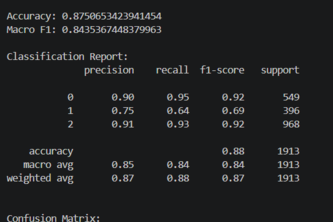
You can't put the answer inside the prediction. NASA's vetting flags are the answer, so my leakage-conservative model drops them. Three classes, 0.836 macro F1 out-of-fold. With the answers: 0.936
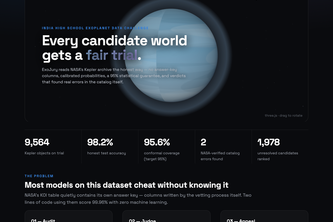
Every Kepler candidate gets a fair trial: a calibrated verdict, a 95% statistical guarantee, and an AI-written opinion — from a pipeline that found real errors in NASA's own catalog.
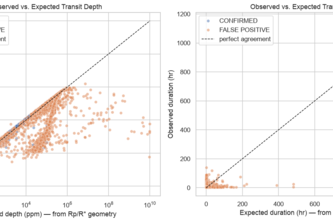
We check whether a candidate exoplanet's own measurements actually agree with the laws of physics -real planets do, false positives don't.
An intelligent ML framework designed to assist in the discovery and classification of potential exoplanets by combining multiple advanced AI models to deliver reliable, and interpretable predictions.
86.4% F1-score using physics features only. No diagnostic flag shortcuts.
AI-powered exoplanet classification using NASA's Kepler data.
ML classifier for NASA Kepler exoplanet data — finds and removes hidden data leakage, then ranks unresolved candidates by likelihood of being real planets.
“AI-powered classifier that separates real Kepler exoplanets from false positives using NASA’s KOI and FPP catalogs.”
EcoTracker is an AI-powered platform that helps users track sustainable habits, measure carbon footprint, and receive personalized insights to build a greener and more sustainable future.
Machine Learning Classification of NASA Exoplanets using Python
AI "AI would be used
ExoDetect AI leverages machine learning to discover hidden worlds by classifying NASA exoplanet candidates with accurate, explainable, and data-driven prediction models.
An explainable AI platform that analyzes NASA exoplanet data, predicts planetary candidates, and reveals the reasoning behind every prediction.
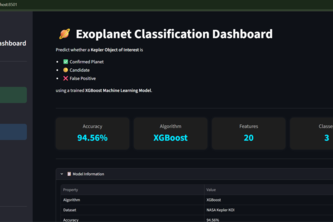
An end-to-end ML application that classifies NASA Kepler Objects of Interest into Confirmed, Candidate, or False Positive using XGBoost (94.56% accuracy) with FastAPI and Streamlit.
Sorting real exoplanet signals from noise in NASA's Kepler data, and ranking which unresolved candidates are most likely to be real planets.
Consciousness cycle navigation platform with Mayan calendars and syntregic feedback, which merges the ancient calendar system: The Tzolk'in (260 days)and the Haab' (365 days).
An explainable XGBoost model that classifies NASA Kepler exoplanet candidates into Confirmed, Candidate, or False Positive using real astronomical data.
Beyond predictions. Beyond black boxes. kAsteria transforms complex astronomical data into explainable discoveries, empowering anyone to explore the universe with confidence.
Physics Informed AI for Exoplanet Verification and Bio-Potential Assessment
Find Exoplanets, In the Snap of Your Fingers!
Our AI analyzes satellite imagery to map disaster frontlines in real time, giving first responders instant boundary maps to act faster and save lives
1 – 24 of 61